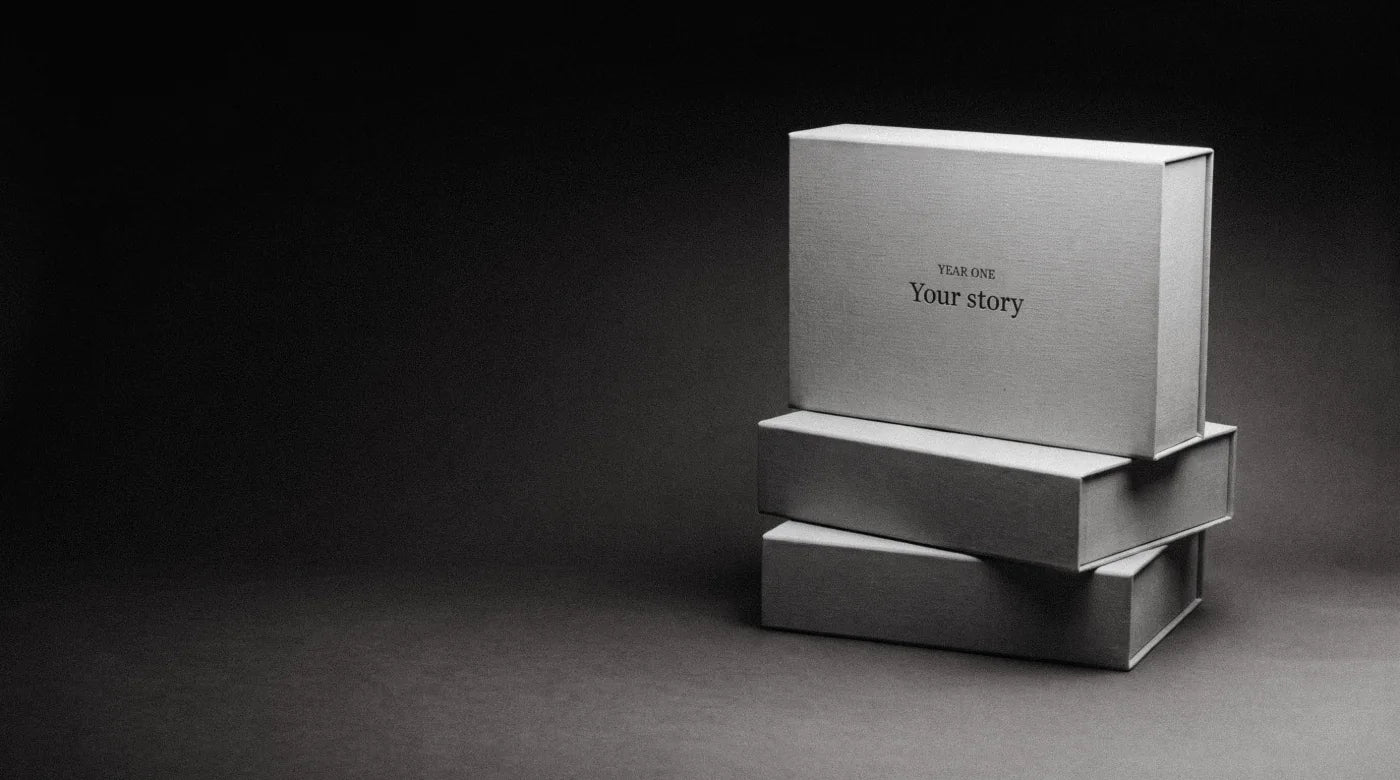
Three baby keepsake boxes stacked, the top one with “Year one · Your story” on the lid, in black and white

How to use your keepsake box

You're holding something that will outlast the noise of everyday life. This guide walks you through everything inside your Hareloom box — what each piece is for, how to use it, and a few ideas to make the most of the first year.

Twelve pieces, one year

Each component has a single job. Nothing here needs to be finished in a week — most of it is meant to be returned to, slowly, as the year gives you something to put in it.

One booklet

Growing up booklet

The booklet unfolds into eight prompts: milestones, firsts, and favourites — filled in when the moment feels right, not all at once. Open it at the right moment for each section, and close it again until the next one comes.

Some prompts belong to the very first days — the birth details, the homecoming, the people who were there. Fill those in while everything is still raw and fresh. Others only make sense later, when personality starts to show: what they like, what makes them laugh, what you notice about who they're becoming.

"Your Firsts" — first smile, first laugh, first solid food, first step — can be filled in as each moment happens, or in one sitting at the end of the year. Either works.

Four envelopes

Things to hold

Ultrasound
Your favourite scan, or a few. Write the date and how many weeks you were on the back before you seal it.
Hospital tag
Both hospital identification bands — the baby's and yours. Add the bassinet name card if you have it.
Letter to you
Write this letter early, while the feelings are still close to the surface. It doesn't have to be long or perfect. Seal it, and let it wait.
Lock of hair
From a first haircut. No deadline — six months or eighteen. Tuck a note inside with the date and their age.

One box

Photographs

One idea that works beautifully: choose one photograph from each month of the first year — twelve prints in total — and let them tell the story of how much has changed.

Or simply gather the ones that matter most. There's no set number. A few prints, labelled on the back with a date and a line of context, are enough to tell the year. Even three or four images that mark the biggest moments will mean more than you expect, decades from now.

Three pouches

Fabric keepsakes

Clothes
For the first outfit they came home from the hospital in, or the very first thing they wore.
Shoes
For the first shoes — even soft shoes count.
Dummy
For the favourite dummy, if they used one.

One sleeve

Little voices

The sleeve holds five small blank cards. Use them however feels right:

  • Write a first word on each card as it appears — the date, the context, how they said it.
  • Write sounds that came before words — the babble, the laughs, the sounds that were almost words.
  • Ask family members to write down the words they heard first.

Add cards as things happen. These are the notes that memory alone won't keep.

Two cards

Handprint & footprint

The best time is between birth and three months — before the hands and feet grow too quickly. That said, if you're reading this later, it's still worth doing.

  1. Choose a calm moment — after a feed, when your baby is relaxed.
  2. Apply a very thin layer of water-based finger paint with a small sponge or brush.
  3. Place the baby's hand or foot firmly onto the card, applying gentle, even pressure.
  4. Lift straight up — don't drag.
  5. Wash their hand or foot immediately with warm water.
  6. Let the card dry completely before placing it back in the box.

Do a few practice prints on scrap paper first. The first one is rarely the best one.

This box is yours to use your way. Not every component will feel relevant to your family — skip what doesn't apply and make the most of what does.

Add things that matter to you

The box is curated, but not sealed. There is room for the things only your family would think to keep.

Photograph what doesn't fit. Larger items — a hospital blanket, a gift too big to store — can be documented with a photo placed in the box. The memory is preserved even if the object isn't.

  • Write on the back who came — in a few years the names will matter more than the design.
  • If yours went out digitally, print one copy now.
  • Something that was genuinely held and chewed, not the one that sat on a shelf looking good.
  • Ask in the first weeks. People write more freely while the baby is still new to them.
  • Add a line about why it mattered. The words on their own won’t carry the reason back.

How to keep it for decades

  1. Label everything

    Write dates on the back of photos, on the outside of envelopes. Memory fades faster than you expect. A date anchors everything.

  2. Wash and dry the fabric items

    Make sure any fabric items are clean and fully dry before folding them away. Even slight damp can cause discolouration over time.

  3. Add a silica gel sachet

    If you live in a humid area, tuck one inside the box — it absorbs moisture and protects paper and fabric from damp damage.

  4. Store in a cool, dry place

    A wardrobe shelf or a drawer indoors is ideal. Avoid attics, garages, and basements — heat, cold, and moisture are the enemies of paper and fabric.

The box is not just for you to keep. It’s for them to receive.

When your child is old enough to understand — seven, eight, ten years old — open the box together. Let them hold the handprint card. Read them the letter. Show them the ultrasound. The box is not just for you to keep. It's for them to receive.